

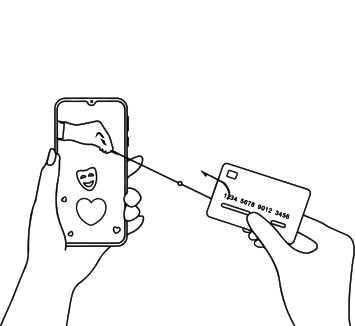
- Celebrity romance scams are among the most paradoxical yet effective forms of fraud in Europe – fraudsters impersonate public figures to establish emotional relationships with victims, and the very implausibility of the scenario, rather than raising suspicion, is interpreted by the victim as proof of its authenticity, because the improbability of being “chosen” by a celebrity is perceived as evidence of a unique and genuine connection.
- The success of celebrity romance scams is driven by specific cognitive mechanisms – authority bias causes the victim to trust a perceived high-status individual, the familiarity effect creates an illusion of existing acquaintance through media exposure, and parasocial interaction produces a sense of personal connection with someone the victim has never met, collectively bypassing the critical evaluation that would normally be triggered by an implausible scenario.
- The operational structure follows the same pattern as standard romance fraud but is amplified by celebrity status – prolonged trust building, emotional dependency, isolation through demands for secrecy (“my public status requires discretion”), and gradual transition to financial requests framed as temporary difficulties or shared opportunities, with funds typically transferred through international bank transfers or cryptocurrency.
- Victims of celebrity romance scams voluntarily transfer funds under the genuine belief that they are helping someone they are in a relationship with, which complicates recovery compared to unauthorised transactions – but recovery remains achievable through bank recall, chargeback, civil proceedings, criminal complaints, regulatory referrals, interim measures, and asset tracing, provided the victim acts immediately upon discovering the fraud.
- Veritas Advisory Group is a specialised structure with over 50 lawyers across EU countries, Switzerland, and the United Kingdom, focused exclusively on fraud and asset recovery, with over 7 years of experience, over 100 successful fund recovery cases, and the ability to launch civil, criminal, and regulatory procedures simultaneously in multiple jurisdictions from the first day of the client’s engagement.
Why Celebrity Status Reduces Scepticism Instead of Increasing It
The intuitive expectation is that the involvement of a famous person should heighten scepticism – the more recognisable the name, the less likely the scenario, and therefore the more suspicious the contact should appear. In reality, the opposite occurs. Celebrity status activates several cognitive mechanisms simultaneously that work to suppress, rather than enhance, critical evaluation. Authority bias causes the victim to perceive a well-known individual as inherently trustworthy – fame, success, and public recognition are unconsciously associated with reliability and good character, even though there is no logical connection between public status and personal integrity. The familiarity effect creates a powerful illusion of existing acquaintance – the victim has seen this person in films, interviews, social media posts, and news coverage, and this exposure generates a sense of “knowing” them that feels personal even though it is entirely one-directional. Parasocial interaction – a well-documented psychological phenomenon in which individuals develop a sense of personal connection with media figures they have never met – means that the victim enters the interaction with an emotional predisposition toward the “celebrity” that would not exist with an unknown contact. The result is that the victim does not perceive the communication as a random, unsolicited contact from a stranger – they perceive it as the continuation of an already-existing “relationship” formed through years of media exposure. The fraudster exploits this pre-existing emotional foundation, building on it rather than creating trust from nothing.The Illusion of “Exclusive Selection” as the Central Trigger
The most powerful psychological mechanism in celebrity romance scams is the creation of a sense of unique, personal selection. The fraudster constructs a narrative in which the victim has been individually chosen by the celebrity – not randomly contacted but specifically identified and selected from among millions of potential connections. The language is precisely calibrated: “I chose you because you are different,” “There is something about you that I cannot find in anyone else,” “I cannot trust anyone in my world – you are the only person I feel safe with,” “You are the first real person I have connected with in years.” The paradox that makes this mechanism so effective is that the less probable the scenario, the more powerfully it is perceived as evidence of its authenticity. The victim’s reasoning, operating under emotional influence rather than logical analysis, follows a specific trajectory: this situation is extraordinary and improbable – therefore, if it is happening to me, it cannot be random – it must be genuine, because the only explanation for something this unlikely is that it is real. The improbability is not processed as a risk signal but as confirmation of the victim’s special status – “I have been chosen.” This reinterpretation of impossibility as proof is one of the most counterintuitive aspects of fraud psychology, and it explains why external observers – who evaluate the scenario logically, without emotional involvement – find it incomprehensible that anyone could believe the story.Why an Implausible Scenario Is Perceived as Proof of Authenticity
Under conditions of emotional engagement, logical verification gives way to interpretation through expectations and desires. The mechanism operates through a specific sequence. An emotional connection is established – the “celebrity” provides attention, warmth, understanding, and validation that the victim may not be receiving from other sources. A positive future scenario is constructed – a relationship, partnership, eventual meeting, a shared life. Within this framework, any inconsistencies are not evaluated objectively but are explained within the narrative of the relationship. The inability to meet in person is attributed to the celebrity’s contractual obligations, security requirements, or travel restrictions. The absence of public acknowledgment of the relationship is explained by the need for secrecy and discretion – “my public image requires that we keep this private.” Financial requests are framed as temporary situations – “I am between projects,” “my accounts are frozen due to a legal dispute,” “I need your help just until this is resolved.” In this way, the absurd does not contradict the narrative – it is absorbed into it. Each implausible element is provided with an explanation that, within the emotional framework of the relationship, appears not only acceptable but expected. The victim is not failing to notice the inconsistencies – they are processing them through an emotional lens that converts contradictions into confirmations.The Role of Emotional Investment and Hope
Celebrity romance scams are built almost entirely on hope-based manipulation. The fraudster does not sell facts, evidence, or verifiable claims – they sell an emotional outcome. The victim is offered the prospect of a relationship with a person of extraordinary status – someone admired by millions, someone whose attention confers validation, significance, and social elevation. For the victim, this represents not merely a romantic connection but a transformation of their personal narrative – a story in which they are selected, valued, and loved by someone exceptional. This emotional investment means that the “relationship” becomes not just a communication but a project of the future – plans, expectations, and aspirations are built around it. In this context, doubts are perceived not as rational evaluation but as a threat to the reality the victim has constructed and invested in emotionally. Critical thinking is suppressed because it threatens the emotional outcome the victim desires. Alternative explanations – the most obvious being that the communication is fraudulent – are ignored because accepting them would mean abandoning the future the victim has projected. The deeper the emotional investment, the stronger the resistance to any information that contradicts the narrative – which is precisely why celebrity romance scams often continue for months or years, with cumulative losses reaching extraordinary levels.Typical Red Flags in Fake Celebrity Relationships
Despite the diversity of specific scenarios, celebrity romance scams share a set of consistent indicators that, when recognised, can prevent financial loss.Transfer of Communication Away from Official Platforms
The fraudster initiates contact through a public platform – social media, a fan page, a dating application – but quickly moves the communication to private messaging platforms such as WhatsApp, Telegram, or private email. The stated reason is privacy and security, but the actual purpose is to remove the interaction from environments where the impersonation might be detected or reported. A genuine public figure communicates through verified, official channels – any request to move to an unverified private channel is a primary indicator of fraud.Absence of Verifiable Identity Confirmation
The “celebrity” is unable or unwilling to provide real-time, verifiable proof of identity – a live, unscripted video call in which the person responds to spontaneous questions. Pre-recorded video messages, brief low-quality video clips, and static photographs are not verification – they can be sourced from public media or generated using deepfake technology. In 2026, the increasing sophistication of deepfake tools means that even video calls require critical evaluation, but the complete avoidance of any real-time interaction remains a strong indicator of fraud.Demands for Secrecy
The fraudster insists that the relationship must remain confidential – “my public status does not allow me to disclose personal relationships,” “the media would destroy this if they found out,” “my management has strict rules about private life.” These statements serve to isolate the victim from external perspectives that would immediately identify the fraud. Any romantic contact that requires secrecy from family, friends, and advisors is a definitive indicator of manipulation.Financial Requests
The transition to financial extraction follows the standard romance fraud pattern – requests framed as temporary difficulties, urgent needs, or shared opportunities. The specific context of celebrity impersonation provides additional justification: “my accounts are frozen due to a legal dispute with my management,” “I cannot access my funds while this investigation is ongoing,” “I need to pay privately to avoid media attention.” The use of cryptocurrency is common, as it provides additional anonymity for the fraudster. The fundamental principle is unambiguous: a genuine celebrity does not need money from a private individual. Any financial request, regardless of the explanation, is a definitive indicator of fraud.Behavioural Inconsistency with Actual Celebrity Status
The “celebrity” behaves in ways that are fundamentally inconsistent with the reality of their public status – requesting money from a private individual, communicating through unverified channels, being unable to resolve routine problems through their management, legal team, or financial advisors. These inconsistencies are obvious from outside the emotional framework of the “relationship” but are rationalised by the victim within the narrative constructed by the fraudster.Why Victims Continue Even After Doubts Appear
Even when clear contradictions emerge, victims of celebrity romance scams rarely disengage. The mechanisms are consistent with those observed in all forms of romance fraud but are amplified by the unique dynamics of the celebrity context. Emotional investment – the victim has invested not only time and trust but the deeply personal hope of a transformative relationship – makes disengagement feel like abandoning a future they have already begun to inhabit emotionally. The sunk cost fallacy drives continued engagement: the more that has been invested, the harder it becomes to accept that the investment was directed at a fiction. The fear of loss operates on multiple levels – not only the fear of losing money already transferred but the far more powerful fear of losing the “relationship” and the future it represents. Isolation – systematically maintained through secrecy demands – ensures that the victim has no external perspective to counterbalance the fraudster’s narrative. The result is a self-sustaining behavioural pattern in which the victim’s continued engagement reinforces the framework within which the fraud operates, and each additional action makes disengagement psychologically more costly.Legal and Financial Consequences
The financial consequences of celebrity romance scams are frequently severe, with individual losses reaching tens to hundreds of thousands of euros – and in some cases substantially more. In the majority of cases, funds are transferred voluntarily through international bank transfers (SEPA/SWIFT) or cryptocurrency, which creates specific challenges for recovery. Banks may classify the transactions as authorised and initially refuse recall or chargeback requests on the grounds that the victim confirmed the payments. The cross-border payment chains used in these schemes – with receiving accounts in jurisdictions unrelated to either the victim’s or the purported celebrity’s location, and funds rapidly moved through intermediary structures – require simultaneous legal action across multiple countries. The use of cryptocurrency adds additional complexity: while cryptocurrency transactions are technically irreversible, recovery is possible through blockchain tracing to identify the exchanges and wallets where funds have been moved, judicial applications for freezing orders against regulated exchanges, and identification and pursuit of the individuals behind the wallets. The time-sensitive nature of recovery means that every hour of delay between the discovery of the fraud and the initiation of legal procedures reduces the probability of successful recovery.What to Do If You Are a Victim
The first actions after discovering that you have been the victim of a celebrity romance scam are the most important. Every hour of delay reduces the probability of fund recovery. The immediate priority is to cease all contact with the fraudster – continued communication provides additional time for asset dissipation and additional opportunities for emotional manipulation and further payments. The second priority is to contact your bank immediately – report the fraud, request a recall for SEPA/SWIFT transfers or a chargeback for card payments, and request the blocking of any pending transactions. The third priority is to secure all available evidence: the complete communication history across all platforms, screenshots of the fraudster’s profile and all photographs or media shared, bank statements and transaction records, cryptocurrency wallet addresses and transaction hashes, phone numbers and email addresses used, and any documents or materials received. The fourth priority is to file a criminal complaint with the relevant law enforcement authority. The fifth priority is to seek specialised legal assistance for a professional assessment of recovery mechanisms, optimal jurisdictions, and the strategy for parallel initiation of procedures.Legal Mechanisms for Fund Recovery
Civil Proceedings
Civil litigation is the primary tool for recovering funds lost to celebrity romance scams. Proceedings are filed in the jurisdiction of the defendant’s domicile, the location of assets, or the place where the damage occurred. Grounds include fraudulent misrepresentation, unjust enrichment, breach of contract, and breach of fiduciary duty. The claim is grounded in the principle that consent obtained through the fabrication of an entire identity – including the impersonation of a real public figure – is not valid consent. Civil proceedings can be directed against the fraudster, intermediaries, payment processors, and connected parties who facilitated the scheme or received the funds.Interim Measures – Freezing Orders and EAPO
The European Account Preservation Order (EAPO, Regulation (EU) No. 655/2014) enables the freezing of a fraudster’s bank accounts across all EU member states simultaneously on an ex parte basis – without prior notice to the defendant. For celebrity romance scam cases where funds have been transferred to accounts in multiple jurisdictions, the EAPO is one of the most effective instruments available. The application must be filed immediately upon identification of the fraudster’s accounts. Without interim measures, even a successful court judgment may be unenforceable if the assets have been moved.Criminal Proceedings and Asset Seizure
Criminal proceedings initiate an investigation in which law enforcement authorities gain access to bank records, payment system data, IP logs, platform account data, and digital forensic evidence. Criminal investigation is essential for identifying the individuals behind the fake celebrity identity and tracing the movement of funds. Criminal proceedings can lead to the seizure and confiscation of assets. In cross-border cases, these powers are exercised through Europol, Eurojust, and mutual legal assistance mechanisms.Banking Mechanisms – Recall and Chargeback
Bank recall for SEPA/SWIFT transfers and chargeback for card payments are the fastest recovery mechanisms. A recall is effective only before funds are withdrawn from the recipient’s account – the window is measured in hours. Chargebacks are available within 120 days. In cases where the victim authorised the transfer under fraudulent inducement, the bank may initially refuse, requiring escalation through regulatory complaints and civil proceedings.Asset Tracing
Asset tracing covers bank accounts across multiple jurisdictions, cryptocurrency wallets through blockchain analytics, the network of individuals and structures behind the fraudulent operation, and other assets held by the perpetrators. In cryptocurrency cases, blockchain tracing can identify regulated exchange touchpoints, enabling judicial applications for freezing and disclosure. Asset tracing provides the evidentiary basis for EAPO applications and freezing orders.Cross-Border Nature of Celebrity Romance Fraud
Celebrity romance scams are virtually always cross-border. The fraudster operates from one country, the fake celebrity persona is associated with another, receiving accounts are held in a third jurisdiction, and funds are routed through intermediary structures in a fourth. Effective recovery requires simultaneous action in each relevant jurisdiction – bank recall, criminal complaint, civil proceedings, EAPO, and regulatory referral – all launched in parallel. A sequential approach gives the fraudster time to move assets. A parallel approach cuts off all channels simultaneously. This is why a distributed team of lawyers across multiple countries within a unified strategy is the critical advantage.Common Mistakes Victims Make
The most common mistake is continuing to send money after the first request – each additional transfer extends the payment chain and reduces recoverability. The second is delay – the emotional difficulty of accepting that the celebrity relationship was fraudulent causes victims to wait before seeking help. The third is maintaining contact after discovering the fraud – the fraudster may attempt re-engagement through emotional manipulation or new stories. The fourth is engaging unverified “recovery services” that constitute secondary fraud. The fifth is failing to preserve evidence – deleting conversations, closing platform accounts, or losing access to records before they are documented. Each mistake narrows the recovery window.Practical Protection Measures
Given the specific dynamics of celebrity romance scams, protection should focus not on recognising individual scenarios but on applying consistent principles. The inability to verify the person’s identity through independent means constitutes a high-risk situation. Any request for financial transfer from someone the victim has not met in person is a critical warning signal. Demands for secrecy are an indicator of manipulation. Communication outside official, verified channels represents elevated fraud probability. Mandatory external consultation – with family, friends, or a lawyer – before any financial action is essential. These principles, applied consistently, eliminate the conditions under which celebrity romance scams succeed.The Veritas Advisory Group Approach
Veritas Advisory Group is a specialised structure focused exclusively on the recovery of funds lost to fraud. The firm brings together over 50 in-house and external lawyers across EU countries, Switzerland, and the United Kingdom, with over 7 years of experience handling fraud cases and over 100 successful fund recovery cases. The key elements of the approach are: exclusive specialisation in fraud and asset recovery, a distributed team across multiple jurisdictions, the ability to launch processes simultaneously in several countries from the first day of the client’s engagement, combination of civil, criminal, and regulatory instruments, and case management from the initial assessment through to enforcement and actual fund recovery.Case Methodology
Every case is handled through a structured model. The first stage is the initial analysis and assessment of prospects – the client receives a realistic evaluation of their legal position, available mechanisms, and timelines. The second stage is the collection and analysis of evidence and transactions – documenting the payment chain, identifying recipients and intermediary structures, analysing the digital infrastructure behind the fake identity. The third stage is the development of the legal strategy – determining the optimal jurisdictions, mechanisms, and sequence of actions. The fourth stage is the parallel initiation of procedures – bank recall, chargeback, criminal complaint, regulatory referral, civil proceedings, and interim measures are launched simultaneously. The fifth stage is representation of the client’s interests through to enforcement and actual fund recovery.Free Initial Case Assessment
Veritas Advisory Group provides a free initial assessment that enables the client to understand their legal position, evaluate the prospects for fund recovery, identify the available legal mechanisms, and receive a realistic estimate of timelines and probability of success. This allows the client to make an informed decision about commencing proceedings without financial commitment at the assessment stage.Frequently Asked Questions
A celebrity romance scam is a form of fraud in which the perpetrator impersonates a well-known public figure - an actor, musician, athlete, or public personality - to establish a fabricated romantic relationship with the victim for the purpose of extracting money. The fraudster uses photographs, video content, and biographical details of the real celebrity to create a convincing persona, builds an emotional bond through sustained communication, and introduces financial requests once the victim is sufficiently invested. These schemes exploit the victim's pre-existing emotional connection with the celebrity's public image, the authority and trust associated with fame, and the powerful psychological effect of being "chosen" by someone extraordinary.
The belief is driven by the interaction of several cognitive mechanisms. Authority bias causes the victim to associate fame with trustworthiness. The familiarity effect - built through years of media exposure - creates a sense of already "knowing" the person. Parasocial interaction produces a feeling of personal connection with a public figure the victim has never met. The illusion of exclusive selection - "I chose you specifically" - transforms the improbability of the scenario into perceived evidence of its authenticity. Under emotional engagement, logical evaluation is replaced by interpretation through hopes and desires, and inconsistencies are absorbed into the narrative rather than recognised as warning signs.
Yes, in many cases fund recovery is possible. The probability depends on the speed of the victim's response, the payment method used, the jurisdictions involved, and the available evidence. Bank recall can recover funds within hours. Chargebacks are available within 120 days. The EAPO can freeze accounts across the entire EU. Civil proceedings can achieve enforceable judgments. Even in cryptocurrency cases, recovery is possible through blockchain tracing and freezing of funds on regulated exchanges. The critical variable is speed - the faster the legal response, the higher the probability of recovery. Veritas Advisory Group provides a free initial case assessment.
The most reliable indicators are: the communication is moved from public or official platforms to private messaging channels; the person is unable or unwilling to participate in live, unscripted video calls; secrecy is demanded - the relationship must not be disclosed to anyone; financial requests are made, regardless of the justification; the person's behaviour is inconsistent with the reality of their claimed celebrity status (requesting money from a private individual, being unable to resolve problems through their professional team); and the scenario features recurring crises that each require immediate financial assistance. Any single one of these indicators is sufficient grounds for suspicion; the presence of several virtually guarantees fraud.
Disengagement is prevented by the interaction of emotional investment (time, trust, and hope already committed), the sunk cost fallacy (unwillingness to accept that the investment was wasted), fear of losing the "relationship" and the future it represents, isolation from external perspectives maintained through secrecy demands, and continued emotional pressure from the fraudster. These mechanisms create a self-sustaining pattern in which continued engagement feels less psychologically costly than the alternative - accepting that the relationship, the celebrity, and the future were entirely fabricated.
Celebrity Romance Scams
Celebrity romance scams demonstrate a critical transformation in modern fraud: the attack is directed not at logic but at emotions and perception. The impersonation of a famous person does not make the scam less believable – it makes it more effective, because celebrity status activates cognitive mechanisms that suppress the very scepticism that should be heightened. Victims of celebrity romance scams are not naive – they are people whose emotional needs and cognitive processes were systematically exploited by professionals who understand human psychology. The most important thing a victim can do is act immediately – cease all contact, cease all payments, secure all evidence, notify the bank, and seek specialised legal assistance without delay.
Delay determines the outcome. Bank recall is effective in the first hours. The EAPO must be filed before assets are moved. Chargeback is limited to 120 days. Every day of delay between the discovery of fraud and the commencement of legal procedures reduces the probability of fund recovery.
If you have lost funds as a result of a celebrity romance scam involving European banks, payment institutions, or corporate structures, contact Veritas Advisory Group for a free assessment of your legal position.
Veritas Advisory Group provides professional legal and advisory services to victims of investment and trade fraud in Europe. This article is for informational purposes only and does not constitute legal advice.