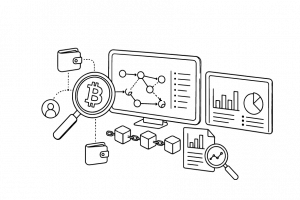
What Is Crypto Tracing and Blockchain Analysis and Why It Matters
When a fraud victim sends cryptocurrency to a fraudulent operator, that transaction does not disappear. It is recorded on the blockchain permanently, immutably, and publicly. Every subsequent movement of those funds through wallets, exchanges, mixing services, and cross-chain bridges generates an additional on-chain record. The blockchain is, in this sense, the most complete financial ledger that has ever existed. The problem is that reading it accurately, following funds through deliberate obfuscation, and producing findings that satisfy legal evidentiary standards requires tools and methodology that go far beyond what any victim or most legal professionals can apply unaided. Forensic blockchain analysis applies those tools systematically. It extracts the complete on-chain record of your funds from the point of transfer, traces their movement through every subsequent transaction, and produces a verified, legally structured fund flow report identifying where the funds currently sit and what legal action can reach them there.
What We Trace in a Cryptocurrency Investigation

- Transaction origin verification and transaction hash documentation
- Receiving wallet and wallet cluster analysis
- Multi-hop tracing across Bitcoin, Ethereum, stablecoins, and major EVM-compatible networks
- Identification of deposits to centralized exchanges and other crypto service providers
- Analysis of mixing services and transaction-obfuscation techniques
- Cross-chain bridge and multi-network transaction tracing
- Fiat conversion and off-ramp identification where supported by available evidence
Crypto Tracing Deliverables: What You Receive
- A documented transaction chronology starting from the verified transaction or wallet.
- A fund-flow map showing relevant wallet, exchange, bridge and service interactions.
- Transaction hashes, wallet addresses, timestamps, blockchain networks and asset amounts.
- Identification of known or probable exchange and service-provider touchpoints, where supported by available data.
- Analysis of obfuscation events, bridge activity and material tracing limitations.
- Identification of points where additional KYC, account or internal-ledger information may need to be obtained from a third party.
- A structured evidence package prepared with chain-of-custody and potential evidentiary use in mind.
- An assessment of potential next steps, including preservation, disclosure, complaints and recovery proceedings.
Who This Is For
- Individuals who transferred cryptocurrency to a fraudulent investment or trading platform.
- Victims of romance-investment or “pig butchering” schemes.
- Businesses affected by cryptocurrency theft, payment diversion or wallet compromise.
- Investors affected by DeFi, token, NFT or portfolio-management fraud.
- Victims who need an independent transaction trace before approaching an exchange, police, regulator or court.
- Lawyers, companies and professional advisers who require documented blockchain evidence for a wider recovery strategy.
Can Cryptocurrency Fraud Proceeds Actually Be Traced and Recovered?
Yes more reliably than most victims believe. Cryptocurrency transactions are immutably recorded on public blockchains. Every transfer, every wallet interaction, and every exchange deposit leaves a permanent on-chain record that forensic analysis can follow. The challenge is not the existence of the record it is the specialist methodology required to read it accurately, trace it through obfuscation techniques, and translate it into evidence that meets European legal standards. Where traced funds reach a regulated exchange or identifiable wallet, legal mechanisms exist in multiple EU jurisdictions to freeze, seize, and return those assets to victims. Veritas Advisory Group s.r.o. applies forensic blockchain analysis to produce that trace and connects it directly to the enforcement action that follows.
- Crypto tracing and blockchain analysis follows fraud proceeds through cryptocurrency networks from the wallet that received your funds to the point where they were converted, withdrawn, or remain recoverable
- Every on-chain transaction is permanent and publicly recorded blockchain analysis extracts a legally admissible fund flow record from that permanent record
- Veritas Advisory Group s.r.o. conducts forensic blockchain analysis for fraud victims pursuing recovery through European courts, regulators, and financial intelligence units
- Crypto tracing identifies the exchanges, wallets, and fiat conversion points where fraud proceeds can be reached by legal enforcement mechanisms
- Blockchain evidence produced to forensic standards is accepted by EU courts, financial regulators, and law enforcement agencies across multiple jurisdictions
Crypto Fraud Cases We Handle
Our crypto investigation work focuses on schemes where blockchain evidence can materially assist in identifying the movement of proceeds, relevant counterparties or enforcement opportunities.
Pig Butchering and Romance Investment Scams
Victim deposits to pig butchering platforms are directed to wallets controlled by the operation typically smart contract addresses or exchange-controlled wallets before being aggregated and moved through a layered extraction process. Blockchain tracing maps each deposit event, the aggregation structure, and the extraction pathway identifying the exchanges and wallets where consolidated proceeds were taken off-chain.
Fake Cryptocurrency Exchanges and Trading Platforms
Fraudulent exchanges receive victim deposits into platform-controlled wallets while displaying false balances and fabricated trading activity. Tracing the actual on-chain movement of deposited funds as opposed to the fictitious account activity shown on the platform establishes the fraud and identifies where victim funds actually went.
DeFi and Yield Farming Fraud
Rug pulls, fraudulent liquidity pools, and exit scams executed through smart contracts leave a complete on-chain record of how victim funds were extracted. Smart contract analysis combined with wallet tracing exposes the extraction mechanism, identifies the controlling wallets, and traces funds from the contract through subsequent wallet hops to exchange deposits or holding addresses.
NFT Fraud and Wash Trading Schemes
Fraudulent NFT projects including rug pulls, fake artist scams, and coordinated wash trading schemes generate traceable on-chain transaction records. Blockchain analysis identifies the wallets that received proceeds, the connections between those wallets and the scheme operators, and the extraction pathway from NFT sale proceeds to final holding addresses.
Crypto Recovery Fraud
Fake crypto recovery services that charge upfront fees to “trace” or “unfreeze” stolen cryptocurrency are themselves traceable. Blockchain analysis of payments made to recovery scammers frequently reveals connections between the recovery operation and the original fraud establishing a coordinated scheme and supporting a combined claim.
Investment Fund and Portfolio Management Fraud
Fraudulent operators accepting crypto as investment capital promising managed portfolio returns leave a complete on-chain record of how deposited funds were handled. Tracing the actual movement of investor capital through the operator’s wallet structure exposes misappropriation, unauthorized transfers, and the ultimate destination of investor funds.
Our Blockchain Analysis Process
Our forensic blockchain methodology follows a structured process designed to produce a complete, legally admissible fund flow record maintaining the evidentiary chain from your original transaction to the final identified asset location.

Phase 1: Transaction Origin Documentation
We collect and verify your original transaction record hash, sending address, receiving address, amount, timestamp, and network confirmation data. This establishes the verified starting point of the blockchain trace and its connection to your specific loss.
Phase 2: Receiving Wallet and Cluster Analysis
We conduct full analysis of the wallet that received your funds including its complete transaction history, connections to other wallets through common control indicators, exchange interactions, and clustering to identify the entity or operation controlling the wallet.
Phase 3: Multi-Hop On-Chain Tracing
We trace all subsequent fund movements from the receiving wallet through every on-chain transfer maintaining the trace through wallet hops, chain bridges, and protocol interactions. Each hop is documented with transaction hash, timestamp, amount, and address data.
Phase 4: Obfuscation Event Analysis
Where funds pass through mixing services, privacy protocols, or complex DeFi interactions, we apply specialist analysis to maintain the trace to the extent technically possible and document each obfuscation event with its legal significance for the proceedings it will support.
Phase 5: Exchange and Off-Ramp Identification
We identify all interactions between traced funds and centralized exchanges including deposit addresses, transaction timestamps, and amount data that establish the basis for legal disclosure requests to the exchange and, where applicable, for emergency account freezing requests.
Phase 6: Fiat Conversion and Terminal Asset Assessment
We identify where traced funds were converted to fiat currency the exchange, the timing, and the approximate amount and assess what institutional records exist at that point and what legal mechanisms apply to access them.
Phase 7: Forensic Blockchain Evidence Report
All findings are compiled into a forensic blockchain evidence report including the complete on-chain fund flow diagram, transaction-by-transaction documentation, wallet analysis findings, obfuscation event records, exchange identification, and a legal enforcement assessment formatted to the evidentiary standards required for European court proceedings, regulatory submissions, and law enforcement referrals.
Legal Enforcement After Blockchain Tracing
Blockchain tracing without a legal enforcement strategy produces information but not recovery. Veritas Advisory Group s.r.o. connects tracing findings directly to the enforcement mechanisms available in European jurisdictions.
Exchange Disclosure Requests and Account Freezing
Where traced funds reached a regulated cryptocurrency exchange including exchanges operating under EU MiCA regulation or national virtual asset service provider (VASP) licenses legal mechanisms exist to compel disclosure of KYC account information and to freeze balances pending civil or criminal proceedings. Our exchange identification findings are structured specifically to support these applications.
Civil Freezing Orders Over Identified Wallets
European courts including courts in England and Wales, the Netherlands, and Germany have issued civil freezing orders over identified cryptocurrency wallets. The prerequisite is a forensic trace to a specific, identified wallet with documented connection to the fraud. Our blockchain evidence report satisfies this requirement.
Financial Intelligence Unit Referrals
Forensic blockchain evidence establishing the movement of fraud proceeds through European financial infrastructure is submitted to national financial intelligence units including UKFIU, FIU-Netherlands, and equivalent bodies supporting AML investigations that can trigger enforcement action independent of civil proceedings.
MiCA and VASP Regulatory Complaints
Under the EU Markets in Crypto-Assets Regulation (MiCA) and national VASP frameworks, licensed crypto service providers have AML and customer protection obligations. Where traced funds passed through a licensed provider that failed to detect or report suspicious activity, regulatory complaints supported by blockchain evidence are both viable and strategically valuable.
Why Clients Choose Veritas Advisory Group s.r.o.
Crypto fraud recovery requires coordination between forensic analysis and legal action. Our role is to ensure that the transaction trace is not treated as an isolated technical exercise, but as part of a broader recovery strategy focused on identifiable counterparties, evidence, jurisdiction and enforceable legal steps.
Case Studies
What Sets Our Crypto Tracing and Blockchain Analysis Apart
- Forensic-grade methodology Analysis applies tools and procedures that produce legally admissible, chain-of-custody documented blockchain evidence
- Multi-network capability Tracing covers Bitcoin, Ethereum, EVM-compatible chains, Solana, Tron, and cross-chain bridge interactions within a single engagement
- Obfuscation-resistant tracing Mixing services, chain hops, and layered wallets are addressed through specialist methodology, not treated as dead ends
- Enforcement-connected output Every tracing finding is assessed for its enforcement implications exchange disclosure, wallet freezing, or FIU referral and connected to the appropriate legal action
- Multilingual case handling Documentation and client communication in English, Mandarin, Cantonese, Japanese, and Korean
- GDPR-compliant confidentiality All client data and blockchain analysis findings are handled under European data protection standards
Frequently Asked Questions
Often, yes. The degree of certainty depends on the blockchain, the route taken, the use of mixers or privacy-enhancing techniques, cross-chain activity and whether funds move into off-chain systems. Tracing does not guarantee recovery, but it can identify the transaction path and potential enforcement points.
Yes, USDT transfers can generally be traced on supported public networks such as Ethereum and Tron because the token movements are recorded on-chain.
Sometimes, but not from the wallet address alone. A self-hosted wallet does not normally contain a public legal name. Identity may become discoverable when the wallet interacts with a KYC-controlled exchange or when other off-chain evidence connects the address to a person or company.
Our tracing capability covers all major blockchain networks including Bitcoin, Ethereum and EVM-compatible chains (BNB Chain, Polygon, Avalanche, Arbitrum), Solana, Tron, and others. For less common or highly privacy-focused networks, traceability is assessed on a case-by-case basis. We advise on what is technically possible for your specific case during the initial scope review.
Mixing services reduce but do not eliminate traceability in all cases. Forensic heuristic analysis can identify funds entering and exiting mixing services with varying degrees of confidence depending on the mixing protocol used and the subsequent transaction pattern. Where a definitive trace through a mixer is not possible, the mixing event itself is documented which is legally significant as evidence of deliberate obfuscation in European proceedings.
On-chain records are permanent a transaction from five years ago is as accessible as one from last week. However, the practical traceability of funds diminishes over time as they move further from origin, are converted to fiat, or enter privacy protocols. Exchange records which are institutional rather than on-chain are subject to retention limits. The on-chain trace can always be conducted; the value of what it reaches depends on how the funds were moved and how quickly we begin.
Legal disclosure requests and freezing applications can be pursued against exchanges outside Europe through mutual legal assistance treaty mechanisms and through the exchange's own compliance obligations under the FATF Travel Rule and applicable national VASP regulations. The enforceability and speed of these mechanisms varies by jurisdiction. We assess this specifically for each identified exchange during the tracing engagement.
Yes. Our forensic blockchain evidence reports are structured to support parallel civil and criminal proceedings. In a number of EU jurisdictions including the Netherlands, Germany, and France parallel civil and criminal tracks are both procedurally available and strategically advantageous. Criminal proceedings can trigger asset seizure independent of the civil timeline, while civil proceedings preserve victim rights to direct compensation.
Transaction reconstruction covers the complete fund flow from your original payment including fiat banking, payment processors, and cryptocurrency as a unified record. Crypto tracing and blockchain analysis is the specialist discipline applied specifically to the on-chain portion of that flow, using forensic blockchain tools and methodology. In cases involving both fiat and crypto transfers, both services are applied as integrated components of a single recovery strategy.
Veritas Advisory Group s.r.o. provides legal and advisory services to fraud victims across Asia-Pacific. We operate in European jurisdictions and work exclusively on cross-border financial fraud cases.