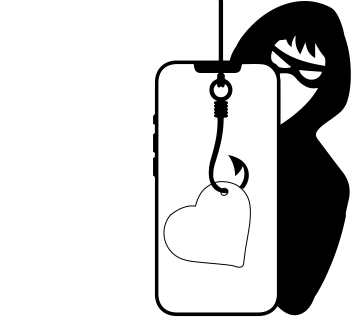
- Romance scams are among the most financially devastating forms of fraud in Europe – they are not about relationships but about the systematic exploitation of loneliness, emotional need, and the fundamental human desire for connection, with fraudsters investing weeks and months in building trust before extracting funds through carefully constructed scenarios that the victim perceives as helping someone they love.
- Loneliness is the primary vulnerability exploited by romance scammers – individuals who lack regular emotional connection are more likely to seek relationships online, form trust faster, rely less on external verification, and maintain engagement even after red flags appear, creating the ideal conditions for prolonged financial exploitation.
- The core mechanism of romance fraud is long-term trust building followed by gradual transition to financial requests – the fraudster creates an illusion of an exclusive emotional bond, establishes dependency through daily communication and shared plans, isolates the victim from family and friends, and introduces financial elements only after the victim is emotionally invested to the point where refusal feels like betrayal of the relationship.
- Victims of romance scams voluntarily transfer funds – often through international bank transfers or cryptocurrency – which complicates recovery compared to unauthorised transactions, but recovery remains achievable through bank recall, chargeback, civil proceedings, criminal complaints, regulatory referrals, interim measures, and asset tracing, provided the victim acts immediately upon discovering the fraud.
- Veritas Advisory Group s.r.o. is a specialised structure with over 50 lawyers across EU countries, Switzerland, and the United Kingdom, focused exclusively on fraud and asset recovery, with over 2 years of experience, over 50 successful fund recovery cases, and the ability to launch civil, criminal, and regulatory procedures simultaneously in multiple jurisdictions from the first day of the client’s engagement.
Romance scams have emerged as one of the most financially and psychologically destructive forms of fraud across Europe. Unlike investment fraud or phishing, romance scams do not target the victim’s desire for profit or exploit a momentary lapse in attention – they exploit the most fundamental of human needs: the need for emotional connection, intimacy, and belonging. The fraudster does not approach the victim with a financial proposition – they approach with attention, warmth, and the promise of a meaningful relationship. The financial element is introduced only after weeks or months of sustained emotional engagement, by which point the victim is deeply invested and perceives the transfer of funds not as a financial risk but as an act of love, support, or partnership. The scale of the problem is reflected in the consistent growth of romance fraud reports across European jurisdictions, with individual losses frequently reaching tens and hundreds of thousands of euros. In the majority of cases, funds are transferred voluntarily – through bank transfers or cryptocurrency – which distinguishes romance fraud from unauthorised transactions and creates specific challenges for recovery. However, fund recovery remains achievable through the parallel application of banking procedures, civil proceedings, criminal complaints, regulatory referrals, and interim measures. The outcome depends on the speed of the victim’s response and the correct legal strategy. This article examines why loneliness creates vulnerability, how romance scams operate at a psychological and operational level, who is most at risk, and what can be done to protect oneself and recover lost funds.
Romance Scam as Exploitation of Emotional Needs
A romance scam is not a relationship that went wrong – it is a deliberate, structured fraud operation that exploits basic human emotional needs. The fraudster identifies a target who demonstrates emotional vulnerability – through dating platforms, social media activity, or data obtained from breaches – and initiates contact designed to fulfil the victim’s unmet needs for attachment, support, and validation. The entire interaction, from the first message to the final payment, is engineered to exploit hope, trust, and the desire for companionship. The victim is not deceived about a financial product or a business opportunity – they are deceived about the existence of a human relationship. This distinction is critical because it explains why romance scam victims often continue transferring funds long after objective indicators of fraud are present: the emotional bond they believe exists is more powerful than rational analysis. The transition from “getting to know someone” to financial involvement is gradual, deliberate, and precisely timed – it occurs only when the fraudster has assessed that the victim’s emotional investment is sufficient to override financial caution. Understanding that romance fraud is the exploitation of emotional needs, not a failure of intelligence or judgment, is essential both for prevention and for the legal framing of recovery cases.
Why Loneliness Increases Vulnerability
Loneliness is the single most significant vulnerability factor in romance fraud. Individuals who experience chronic loneliness – whether due to social isolation, bereavement, divorce, relocation, or the natural reduction of social networks with age – are disproportionately targeted and disproportionately affected. The psychological mechanisms are well-documented. Lonely individuals actively seek emotional connection online, making them more likely to engage with unsolicited contact on dating platforms, social media, and messaging applications. They form trust faster – the emotional relief of finding someone who appears to care, listen, and understand creates a powerful bonding effect that accelerates the trust-building process far beyond what would occur in a non-isolated individual. They are less likely to seek external verification – loneliness often correlates with a reduced social network, meaning fewer people are available to provide an objective perspective on the developing “relationship.” The deficit of regular human communication diminishes critical thinking in the context of emotional interactions – the brain, deprived of social connection, responds more intensely to the provision of that connection, reducing the capacity to evaluate the source critically. These factors combine to create a state of heightened vulnerability that romance scammers systematically identify and exploit. The victim is not naive – they are experiencing a documented psychological response to emotional deprivation that the fraudster deliberately targets.
Long-Term Trust Building: Core Mechanism of Romance Fraud
The defining characteristic of romance fraud – and the factor that distinguishes it from virtually all other forms of financial crime – is the duration and depth of the trust-building phase. Romance scammers do not rush. The initial period of communication typically lasts weeks to months, during which the fraudster makes no attempt to request money or introduce any financial element. This period is dedicated entirely to building the emotional foundation: daily messages, phone calls, voice notes, and in some cases video interactions using stolen or deepfake content. The fraudster demonstrates consistent attention, remembers personal details shared by the victim, provides emotional support during difficult moments, and gradually creates the perception of an exclusive, deeply personal connection. The victim comes to believe that they have found someone who genuinely understands and cares about them. The “relationship” develops through all the stages the victim would expect – initial attraction, deepening connection, expressions of love, discussion of future plans, and the establishment of routines (daily calls, morning messages, shared activities). By the time the financial element is introduced, the victim does not perceive the request as coming from a stranger or a potential fraudster – it comes from someone they love, trust, and have been building a future with. This is the core mechanism: the investment of time and emotional energy in the trust-building phase creates the conditions under which the victim will transfer funds without the critical evaluation they would apply to any other financial decision.
Emotional Dependency and Control
Romance scammers deliberately cultivate emotional dependency as a mechanism of control. The process begins with the establishment of daily communication routines – the victim comes to expect and rely on morning messages, evening calls, and constant availability. The fraudster provides emotional support that the victim may not be receiving from other sources: validation, encouragement, expressions of love, and attention to the victim’s problems and feelings. “Shared plans” – discussions about meeting in person, living together, building a future – create a framework of anticipation that binds the victim emotionally to the fraudster. Over time, this dynamic creates a dependency in which the victim’s emotional wellbeing becomes tied to the continuation of the “relationship.” The fraudster leverages this dependency to control the victim’s behaviour: the victim avoids actions that might jeopardise the relationship (such as questioning inconsistencies or refusing financial requests), prioritises the fraudster’s needs over their own financial security, and experiences significant distress at the prospect of losing the connection. The loss of the ability to objectively assess the situation is not a failure of the victim’s intelligence – it is a predictable consequence of emotional dependency deliberately engineered by the fraudster. Recognising this dynamic is critical for understanding why victims continue to transfer funds even when objective indicators of fraud are present.
Isolation as a Strategic Tool
Isolation is a deliberate strategy employed by romance scammers to prevent the victim from receiving external feedback that would expose the fraud. The fraudster systematically discourages the victim from discussing the “relationship” with family, friends, financial advisors, or other trusted individuals. The arguments used are carefully calibrated to the victim’s psychology: “they wouldn’t understand what we have,” “this is something private between us,” “your family has never supported your happiness,” “I don’t want anyone to interfere with what we’re building together,” “if you tell your bank, they might freeze your account and we won’t be able to meet.” Each of these statements serves a specific function – they frame the victim’s social network as a threat to the relationship, making the victim complicit in their own isolation. The consequence is the elimination of external verification. Family members, friends, or financial advisors who might recognise the warning signs of fraud are excluded from the information loop. The victim makes all decisions in a closed environment where the only source of information and perspective is the fraudster. Every day of isolation is additional time during which the fraud can continue and additional funds can be extracted. The isolation tactic also has a direct impact on fund recovery – the victim does not seek help until the fraud becomes undeniable, by which point significant funds have been transferred and moved through multiple jurisdictions.
Transition from Emotional to Financial Exploitation
The transition from emotional engagement to financial extraction is the most carefully engineered phase of a romance scam. The fraudster does not ask for money directly or abruptly – the request is introduced within the context of the established relationship and framed as a natural extension of mutual care and trust. The most common scenarios include “unforeseen expenses” – a medical emergency, a legal problem, a sudden financial crisis that threatens the fraudster’s ability to continue the relationship or to travel to meet the victim; “travel complications” – the fraudster has booked a flight to meet the victim but encounters a problem (customs fees, a lost passport, an unexpected visa requirement) that requires an immediate payment; and “investment opportunities” – the fraudster introduces a “shared investment” or a “business opportunity” that will benefit both of them, transitioning the romance scam into an investment fraud. The amounts escalate gradually. The first request is typically small – a few hundred euros – to test the victim’s willingness to pay and to establish the precedent. Subsequent requests increase progressively, each accompanied by a new crisis or opportunity. The victim perceives these transfers not as financial transactions but as acts of help, support, and love – the emotional framing completely overrides financial risk assessment. By the time the victim recognises the pattern, the total amount transferred often reaches tens or hundreds of thousands of euros.
Use of Fake Identities and Digital Personas
Romance scammers operate behind carefully constructed fake identities designed to maximise trust and emotional attraction. The fabricated persona typically presents as a professional with a credible and appealing background – a military officer deployed overseas, a doctor working with an international organisation, an engineer on a remote project, a successful business professional. These professions are chosen deliberately: they explain the inability to meet in person (deployment, remote work, travel restrictions), they convey stability and reliability, and they provide a plausible context for the financial crises that will later be introduced. The fake identity is supported by stolen photographs – images taken from the social media profiles of real individuals, often attractively presented – and by comprehensive digital personas including fabricated social media accounts, professional profiles, and backstories. In 2026, deepfake technology has added a new dimension: fraudsters can now generate convincing video content, conduct real-time video calls using face-swapping technology, and create audio messages in a synthetic voice consistent with the persona. This makes the traditional advice to “request a video call to verify identity” increasingly unreliable. The objective is the creation of a digital presence sufficiently convincing that the victim has no reason to question the person’s existence – and every reason to believe they have found a genuine connection.
Psychological Techniques Used in Romance Scams
Romance scammers deploy a systematic set of psychological techniques designed to establish control over the victim’s emotions and, through emotions, over their financial decisions. Love bombing is the initial phase – the victim is overwhelmed with attention, compliments, declarations of love, and expressions of deep connection, creating an intense emotional high and rapid attachment. Urgency is introduced at the point of financial extraction – “I need help right now,” “if I don’t pay by tomorrow, I’ll lose everything,” “this is the only chance we have to be together” – creating pressure to act before the victim can reflect or consult. Guilt is deployed when the victim hesitates – “I thought you cared about me,” “after everything we’ve been through,” “I’ve never asked anyone for help before” – framing the refusal to pay as a betrayal of the relationship. Future promises maintain engagement through the most difficult moments – “once this is resolved, we’ll finally be together,” “I’m working on coming to you,” “our future is worth this” – providing the emotional reward that keeps the victim invested. The central principle is that controlling the victim’s emotions means controlling their decisions. Every financial action the victim takes is the product of deliberate emotional engineering, not independent financial judgment.
Who Is at Risk: Key Target Groups
Socially Isolated Individuals
People who lack regular social interaction – whether due to geographic isolation, limited social networks, disability, or lifestyle factors – are primary targets for romance scammers. The absence of regular human connection creates a deficit that the fraudster fills with consistent, attentive communication. Socially isolated individuals are more likely to form deep emotional bonds with an online contact because the contact represents their primary source of emotional support. The lack of a wider social network also means fewer opportunities for external feedback that might expose the fraud.
Recently Divorced or Bereaved Individuals
People who have recently experienced the loss of a significant relationship – through divorce, separation, or the death of a partner – are in a state of acute emotional vulnerability. They are actively seeking to rebuild emotional connection, are often experiencing grief or loneliness, and may have reduced self-confidence regarding their attractiveness and desirability. Romance scammers identify these individuals through dating platform profiles, social media posts, and behavioural patterns, and specifically tailor their approach to address the victim’s emotional state – offering the comfort, validation, and hope for a new beginning that the victim is seeking.
Middle-Aged and Older Adults
Middle-aged and older adults represent a significant target group for romance fraud due to the combination of financial stability and emotional vulnerability. These individuals are more likely to have substantial savings, property, or pension funds – providing a larger pool of assets for the fraudster to target. They may also demonstrate higher levels of trust in the sincerity of online communications and lower familiarity with the indicators of digital fraud. The intersection of available financial resources and emotional openness makes this demographic disproportionately represented in high-value romance fraud cases.
Digitally Active Users
Individuals who actively use dating platforms, social media, and online communities expose themselves to the attention of romance scammers through their digital presence. Profile information on dating platforms – relationship status, interests, emotional state, photographs – provides the raw material for a targeted approach. Active social media use reveals additional personal details that the fraudster can incorporate into their persona and scenario. The paradox is that digital activity, while increasing exposure to potential fraud, does not necessarily increase the ability to recognise it – the emotional dynamics of romance fraud operate independently of digital literacy.
Why Victims Continue Even After Red Flags
One of the most misunderstood aspects of romance fraud is the victim’s continued engagement after objective warning signs have appeared. This behaviour is not irrational – it is the predictable outcome of documented cognitive and emotional processes. The sunk cost fallacy – the tendency to continue investing in something because of the resources already committed – plays a powerful role: the victim has invested weeks or months of emotional energy, has shared intimate details of their life, and has already transferred significant funds. Abandoning the “relationship” means acknowledging that all of this investment was directed at a fiction, which is psychologically devastating. Denial operates as a protective mechanism – the victim’s mind resists the conclusion that the person they love does not exist, selectively interpreting information to preserve the belief in the relationship. Rationalisation provides explanations for inconsistencies – “there must be a good reason they couldn’t make the video call,” “the situation in their country is complicated,” “they’ll pay me back once their problem is resolved.” The fear of losing the relationship – which, for the victim, feels entirely real – is often more powerful than the fear of financial loss. Emotional dependency, cultivated over months of daily interaction, overrides logical analysis. These mechanisms explain why romance fraud victims can be intelligent, educated, and financially sophisticated individuals who nonetheless continue to transfer funds – the manipulation targets emotional processing, which operates independently of intellectual capacity.
Red Flags of Romance Scams
Recognising the warning signs of a romance scam before significant funds are transferred is the most effective form of protection. The most reliable indicators are: rapid escalation of emotional intensity – declarations of deep love, commitment, or exclusive connection within days or weeks of initial contact are a hallmark of romance fraud, as genuine emotional bonds develop over time through shared experience, not through messaging alone. Refusal or inability to conduct video calls – or the use of brief, low-quality video that could be pre-recorded or deepfake-generated – is a strong indicator that the person’s appearance does not match their claimed identity. Recurring crises – a pattern of emergencies, each of which requires immediate financial assistance, is the operational structure of the fraud. Requests for money or cryptocurrency – any request for financial transfers, regardless of the reason or emotional framing, from someone the victim has never met in person is a definitive indicator of fraud. Inconsistencies in the person’s story – contradictions in biographical details, unexplained changes in circumstances, or details that do not align with verifiable facts. Pressure to keep the relationship secret – any discouragement of discussing the relationship with family, friends, or advisors. The presence of several of these indicators virtually guarantees that the interaction is a romance scam.
Legal and Financial Consequences
The financial consequences of romance fraud are frequently severe – individual losses of tens to hundreds of thousands of euros are common, with some cases reaching into the millions. The voluntary nature of the transfers – made by the victim under the genuine belief that they are helping someone they love – creates specific legal challenges for recovery. Banks may classify the transactions as authorised and initially refuse recall or chargeback requests. The payment channels used in romance fraud typically involve international bank transfers (SEPA/SWIFT) to accounts in jurisdictions different from both the victim’s and the fraudster’s actual location, cryptocurrency transfers to wallets controlled by the fraudster, and in some cases payment through intermediary platforms or money transfer services. The cross-border nature of the payment chain – with the victim in one country, receiving accounts in another, and funds rapidly moved through intermediary structures in a third – requires simultaneous legal action in multiple jurisdictions. The time-sensitive nature of romance fraud recovery means that every hour of delay between the discovery of the fraud and the initiation of legal procedures reduces the probability of recovery, as funds are systematically moved through layered payment chains designed to place them beyond reach.
How to Protect Yourself
Protection against romance fraud requires awareness of the psychological dynamics that make it effective and the application of consistent verification practices. The first principle is maintaining healthy scepticism toward online relationships, particularly those that develop unusually quickly or intensely – genuine emotional connections require time and in-person interaction to develop. The second is systematic identity verification: conducting reverse image searches on photographs shared by the person, analysing their social media profiles for consistency and authenticity, verifying claimed professional credentials or affiliations through independent sources, and insisting on live, unscripted video calls. The third is an absolute refusal to transfer funds to anyone the victim has not met in person – regardless of the emotional context, regardless of the urgency of the stated reason, regardless of the depth of the perceived connection. No legitimate romantic partner will require financial transfers before meeting in person. The fourth is consultation with trusted third parties – family members, friends, or professional advisors – about any developing online relationship, particularly if the other person has discouraged such sharing. The fifth is awareness of the warning signs described in this article and the willingness to act on them, even when doing so is emotionally difficult.
What to Do If You Are a Victim
The first actions after discovering that you have been the victim of a romance scam are the most important. Every hour of delay reduces the probability of fund recovery. The immediate priority is to cease all contact with the fraudster – continued communication provides additional time for asset dissipation and additional opportunities for the fraudster to extract further payments through emotional manipulation. The second priority is to contact your bank immediately – report the fraud to the bank’s fraud department, request the initiation of a recall for SEPA/SWIFT transfers or a chargeback for card payments, and request the blocking of any pending or suspicious transactions. A bank recall is the fastest recovery mechanism available – but it is effective only before the funds are withdrawn from the recipient’s account, and this window is measured in hours. The third priority is to secure all available evidence: the complete communication history across all platforms (dating apps, messaging platforms, email, social media), screenshots of the fraudster’s profile and photographs, bank statements and transaction records, cryptocurrency wallet addresses and transaction hashes, phone numbers and email addresses used by the fraudster, and any documents, contracts, or materials received. This evidence forms the basis of every subsequent legal procedure. The fourth priority is to file a criminal complaint with the relevant law enforcement authority. The fifth priority is to seek specialised legal assistance – a professional assessment of the circumstances determines the available recovery mechanisms, the optimal jurisdictions, and the strategy for parallel initiation of procedures.
Legal Mechanisms for Fund Recovery
Civil Proceedings
Civil litigation is the primary tool for recovering funds lost to romance fraud. Proceedings are filed in the jurisdiction of the defendant’s domicile, the location of assets, or the place where the damage occurred. Grounds include fraudulent misrepresentation, unjust enrichment, breach of contract, and breach of fiduciary duty. Civil proceedings can be brought against the fraudster, against intermediaries who received or transmitted the funds, against payment processors, and against nominee directors or connected parties who facilitated the scheme. In romance fraud cases, the claim is grounded in the principle that consent obtained through the fabrication of an entire relationship – a fictitious identity, fictitious feelings, and fictitious circumstances – is not valid consent. Civil proceedings achieve recovery of the full amount of the loss, compensatory damages, and enforcement through EU mechanisms.
Interim Measures – Freezing Orders and EAPO
The European Account Preservation Order (EAPO, Regulation (EU) No. 655/2014) enables the freezing of a fraudster’s bank accounts across all EU member states simultaneously on an ex parte basis – without prior notice to the defendant. For romance fraud cases where funds have been transferred to accounts in multiple jurisdictions, the EAPO is one of the most effective instruments available. The EAPO application must be filed immediately upon identification of the fraudster’s accounts. Without interim measures, even a successful court judgment may be unenforceable if the assets have been moved by the time the judgment is obtained.
Criminal Proceedings and Asset Seizure
Criminal proceedings initiate an investigation in which law enforcement authorities gain access to bank records, payment system data, IP logs, telecommunications operator records, platform account data, and digital forensic evidence. Criminal investigation is the primary tool for identifying anonymous fraudsters operating behind fake identities and tracing the movement of funds through cross-border payment chains. Criminal proceedings can lead to the seizure and confiscation of the fraudster’s assets. In cross-border cases, these powers are exercised through international cooperation mechanisms – Europol, Eurojust, and mutual legal assistance mechanisms.
Banking Mechanisms – Recall and Chargeback
Bank recall for SEPA/SWIFT transfers and chargeback for card payments through Visa/Mastercard are the fastest recovery mechanisms available. A recall is effective only before the funds are withdrawn from the recipient’s account – the window is measured in hours. Card chargebacks are available within 120 days. PSD2 requires banks to refund unauthorised transactions within one business day. In romance fraud cases where the victim authorised the transfer under fraudulent inducement, the bank may initially refuse the recall on the grounds that the transaction was authorised. In such cases, the grounds for the claim shift to fraudulent misrepresentation – the victim’s consent was obtained through the fabrication of an entire identity and relationship – and regulatory complaints and civil proceedings against the bank may become necessary.
Asset Tracing
Asset tracing is the process of identifying and locating the fraudster’s assets for subsequent recovery. In romance fraud cases, asset tracing covers bank accounts across multiple jurisdictions, cryptocurrency wallets through blockchain analytics, the network of individuals and corporate structures behind the fraudulent operation, real estate and other assets held by the perpetrators, and connections to broader fraud networks that may hold pooled funds. Asset tracing provides the evidentiary basis for EAPO applications and freezing orders – without locating the assets, interim measures are impossible. In cryptocurrency cases, blockchain tracing can identify the exchanges and wallets where funds have been moved, enabling judicial applications for freezing and disclosure.
Cross-Border Nature of Romance Fraud
Romance scams are virtually always cross-border in nature. The fraudster may operate from one country while presenting a persona based in another, with receiving bank accounts in a third jurisdiction and funds routed through intermediary structures in a fourth. This cross-border structure is deliberately used to complicate investigation and place assets beyond the reach of any single jurisdiction. Effective recovery requires simultaneous action in each relevant jurisdiction – the bank recall through the sending bank, the criminal complaint in the country of the recipient’s account, civil proceedings in the jurisdiction of the defendant’s domicile or asset location, the EAPO filed in an EU member state court, and the regulatory complaint in the country where the financial institution is licensed. All of these procedures must be launched in parallel, not sequentially. A sequential approach gives the fraudster time to move assets after each step. A parallel approach cuts off all channels simultaneously. This is precisely why a distributed team of lawyers working across multiple countries within a unified strategy is the critical advantage in romance fraud recovery cases.
Common Mistakes Victims Make
Victims of romance fraud frequently make mistakes that significantly reduce the probability of fund recovery. The most common is continuing to send money after the first request – each additional transfer reduces the total amount recoverable and extends the payment chain that must be traced. The second is delay – the emotional difficulty of accepting that the relationship was fraudulent often causes victims to wait days, weeks, or even months before seeking help, during which time funds are moved beyond reach. The third is maintaining contact with the fraudster after discovering the fraud – the fraudster may attempt to re-engage the victim through emotional manipulation, apologies, or new stories, extracting further payments or gathering information that compromises the recovery effort. The fourth is engaging unverified recovery services – a secondary fraud industry specifically targets romance fraud victims, offering “guaranteed” fund recovery in exchange for upfront payments, which constitutes a second layer of fraud. The fifth is failing to preserve evidence – deleting conversations, closing dating platform accounts, or losing access to communication records before they are secured and documented. Each of these mistakes narrows the window for recovery and reduces the effectiveness of legal procedures.
The Veritas Advisory Group s.r.o. Approach
Veritas Advisory Group s.r.o. is a specialised structure focused exclusively on the recovery of funds lost to fraud. The firm brings together over 50 in-house and external lawyers across EU countries, Switzerland, and the United Kingdom, with over 2 years of experience handling fraud cases and over 50 successful fund recovery cases. The key elements of the approach are: exclusive specialisation in fraud and asset recovery, a distributed team across multiple jurisdictions, the ability to launch processes simultaneously in several countries from the first day of the client’s engagement, combination of civil, criminal, and regulatory instruments, and case management from the initial assessment through to enforcement and actual fund recovery.
Case Methodology
Every case is handled through a structured model. The first stage is the initial analysis and assessment of prospects – the client receives a realistic evaluation of their legal position, available mechanisms, and timelines. The second stage is the collection and analysis of evidence and transactions – documenting the payment chain, identifying recipients and intermediary structures, analysing the digital infrastructure behind the fake identity and the fraud operation. The third stage is the development of the legal strategy – determining the optimal jurisdictions, mechanisms, and sequence of actions. The fourth stage is the parallel initiation of procedures – bank recall, chargeback, criminal complaint, regulatory referral, civil proceedings, and interim measures are launched simultaneously. The fifth stage is representation of the client’s interests through to enforcement and actual fund recovery.
Free Initial Case Assessment
Veritas Advisory Group s.r.o. provides a free initial assessment that enables the client to understand their legal position, evaluate the prospects for fund recovery, identify the available legal mechanisms, and receive a realistic estimate of timelines and probability of success. This allows the client to make an informed decision about commencing proceedings without financial commitment at the assessment stage.
Frequently Asked Questions
A romance scam is a form of fraud in which the perpetrator creates a fake identity and establishes a fabricated romantic relationship with the victim for the sole purpose of extracting money. The fraudster invests weeks or months in building emotional trust and dependency before introducing financial requests - typically framed as emergencies, travel costs, or shared investment opportunities. The victim transfers funds voluntarily, believing they are helping someone they love. Romance scams are among the most financially devastating forms of fraud, with individual losses frequently reaching tens to hundreds of thousands of euros.
Lonely individuals are targeted because loneliness creates the precise psychological conditions that romance scammers exploit. People who lack regular emotional connection actively seek it online, form trust more quickly, are less likely to seek external verification from friends or family, and experience a stronger emotional response to the attention and affection provided by the fraudster. The deficit of human connection reduces critical thinking specifically in the context of emotional interactions, making lonely individuals disproportionately susceptible to the trust-building and dependency mechanisms that are central to romance fraud.
Yes, in many cases fund recovery is possible. The probability depends on the speed of the victim's response, the payment method used, the jurisdictions involved, and the quality of the available evidence. Bank recall can recover funds within hours if initiated before funds are withdrawn. Card chargebacks are available within 120 days. The EAPO can freeze the fraudster's accounts across the entire EU. Civil proceedings can achieve enforceable judgments. Even in cryptocurrency cases, recovery is possible through blockchain tracing and freezing of funds on regulated exchanges. The critical variable is speed - the faster the legal response, the higher the probability of recovery.
This behaviour is the predictable outcome of documented psychological processes, not a failure of intelligence. The sunk cost fallacy drives continued investment to justify what has already been spent. Denial protects the victim from the devastating realisation that the relationship was fictional. Emotional dependency - cultivated over months of daily interaction - overrides logical analysis. The fear of losing the "relationship" is often more powerful than the fear of financial loss. These mechanisms operate independently of the victim's education, intelligence, or professional sophistication - they target emotional processing, which functions separately from rational thinking.
Immediately cease all financial transfers - do not send any further money regardless of the reason given. Do not alert the suspected fraudster to your suspicions, as this may prompt them to destroy evidence or accelerate asset movement. Secure all evidence: export the complete communication history, take screenshots of profiles and photographs, preserve all bank statements and transaction records. Contact your bank to report suspected fraud and request recall or chargeback. File a criminal complaint with the relevant law enforcement authority. Seek specialised legal assistance for a professional assessment of your recovery options. Veritas Advisory Group s.r.o. provides a free initial case assessment.
Why Lonely People Are More Likely to Become Victims of Romance Scams
Romance scams are not a consequence of naivety – they are the product of systematic psychological manipulation that exploits the most fundamental of human needs. Victims of romance fraud are not people who failed to exercise caution – they are people who were subjected to deliberate, prolonged, and professionally executed emotional engineering designed to override rational decision-making. The most important thing a victim can do is act immediately – cease all contact, cease all payments, secure all evidence, notify the bank, and seek specialised legal assistance without delay.
Delay determines the outcome. Bank recall is effective in the first hours. The EAPO must be filed before assets are moved. Chargeback is limited to 120 days. Every day of delay between the discovery of fraud and the commencement of legal procedures reduces the probability of fund recovery.
If you have lost funds as a result of a romance scam involving European banks, payment institutions, or corporate structures, contact Veritas Advisory Group s.r.o. for a free assessment of your legal position.
Veritas Advisory Group s.r.o. provides professional legal and advisory services to victims of investment and trade fraud in Europe. This article is for informational purposes only and does not constitute legal advice.